

Tranexamic Acid: The Dark-Spot Ingredient Dermatologists Kept to Themselves
It started life as a surgical medicine. Then dermatologists noticed something unexpected: it quiets the exact signals that tell skin to overproduce pigment. Here is what tranexamic acid actually is, what the research shows, and how to read the percentage on the label.

If you struggle with melasma, sun spots, or the stubborn shadows acne leaves behind, you have probably cycled through vitamin C, niacinamide, maybe even prescription creams. Tranexamic acid is the ingredient most people haven’t tried — and it works differently from all of them. Instead of bleaching pigment that already exists, it interrupts the conversation between stressed skin cells and the melanocytes that make pigment in the first place.
That difference matters, because for discoloration triggered by sun and hormones — the hardest kind to treat — quieting the signal is often more effective than scrubbing at the stain.
A Medicine First, a Cosmetic Second
Tranexamic acid was synthesized in Japan in the 1960s by the husband-and-wife research team Shosuke and Utako Okamoto. It is a derivative of the amino acid lysine, and for decades its job had nothing to do with beauty: it is used in hospitals worldwide to control bleeding during surgery, and it sits on the World Health Organization’s List of Essential Medicines.
The skincare chapter began in 1979, when Japanese physician Nijo Nijor reported something curious: a patient treated with tranexamic acid saw her melasma visibly lighten. Dermatologists spent the following decades working out why — and the answer turned out to be elegant. The same anti-plasmin mechanism that steadies bleeding also mutes the inflammatory messengers (plasmin, prostaglandins, and vascular growth factors) that ultraviolet light and hormones use to switch melanocytes into overdrive.
Tranexamic acid is one of the only topical ingredients that addresses melasma’s trigger — the signal — rather than only the pigment it leaves behind.
What the Studies Actually Show
Tranexamic acid has something rare in cosmetic ingredients: a body of randomized, controlled research — much of it against hydroquinone, dermatology’s gold-standard lightener.
In a 12-week, split-face, double-blind trial, topical 3% tranexamic acid performed comparably to a hydroquinone-plus-steroid combination in reducing melasma — with fewer reported side effects. For a gentle, non-prescription molecule to match the prescription benchmark is precisely why dermatologists took notice.
Ebrahimi B, Naeini FF. Journal of Research in Medical Sciences. 2014;19(8):753–757.
A study in Clinical and Experimental Dermatology found that 23 weeks of topical tranexamic acid significantly improved melasma while reducing epidermal pigmentation, and — under the microscope — decreased the vessel counts and mast cells that keep melasma smoldering.
Kim SJ, et al. Clinical and Experimental Dermatology. 2016;41(5):480–485.
Meta-analyses pooling randomized controlled trials of tranexamic acid — topical, oral, and injected — consistently report significant reductions in melasma severity scores, with topical use standing out for its mild, temporary side-effect profile.
Konisky H, et al. Journal of Cosmetic Dermatology. 2023;22(4):1197–1206.
The Percentage Is the Whole Story
Here is what most labels won’t tell you: the average tranexamic acid serum sold online contains just 2–3%, and many list the ingredient without disclosing a percentage at all. The clinical research above was largely conducted at 3–5%. Professional-grade formulations — the strength found in dermatology-adjacent lines — reach 10%.
Typical of mass-market serums. Can help maintain results, but sits below most of the concentrations studied.
Where most published trials were run — the doses shown to rival hydroquinone in head-to-head studies.
The strength of professional formulations — a full-dose approach for stubborn, recurring discoloration.
It Takes Time — and It Demands Sunscreen
No pigment-correcting ingredient is an overnight fix, and anyone promising otherwise is selling you something. Pigment forms deep and surfaces slowly; correcting it follows your skin’s own renewal calendar. With steady, twice-daily use, visible results usually take anywhere from 2 to 12 weeks — earliest for post-blemish marks, longest for deep, hormonal melasma.
And one rule is non-negotiable: always wear sunscreen during the day. UV exposure is the very signal tranexamic acid works to silence — skip SPF, and you are reigniting new spots while fading old ones. Broad-spectrum SPF every morning isn’t an add-on to this treatment; it is half of it.
Skin acclimates. Hydration and tone begin to even; spots unchanged. Stay the course.
Fresh post-blemish marks are often first to soften as surface pigment turns over.
Sun spots and melasma patches begin to blur at the edges and lighten in the center.
The window where studies measured their results. Consistency — and daily SPF — pays here.
A Quick Label Checklist
Look for a disclosed percentage. “Tranexamic acid” buried mid-list with no number usually means a token dose.
Check for a hydrating base. Pairing with hyaluronic acid offsets the dryness higher actives can bring.
Commit to the timeline. Judge results at 8–12 weeks, not 8–12 days.
Buy sunscreen the same day. Without daily SPF, you are treating spots and creating them at once.
Ebrahimi B, Naeini FF. Topical tranexamic acid as a promising treatment for melasma. Journal of Research in Medical Sciences. 2014;19(8):753–757.
Kim SJ, Park JY, Shibata T, Fujiwara R, Kang HY. Efficacy and possible mechanisms of topical tranexamic acid in melasma. Clinical and Experimental Dermatology. 2016;41(5):480–485.
Konisky H, Balazic E, Jaller JA, Khanna U, Kobets K. Tranexamic acid in melasma: A focused review on drug administration routes. Journal of Cosmetic Dermatology. 2023;22(4):1197–1206.
World Health Organization. WHO Model List of Essential Medicines — tranexamic acid (medicines affecting the blood).
Citations reflect published research on tranexamic acid at the concentrations and routes studied — not clinical trials of this finished formula. Individual results vary. Not medical advice.

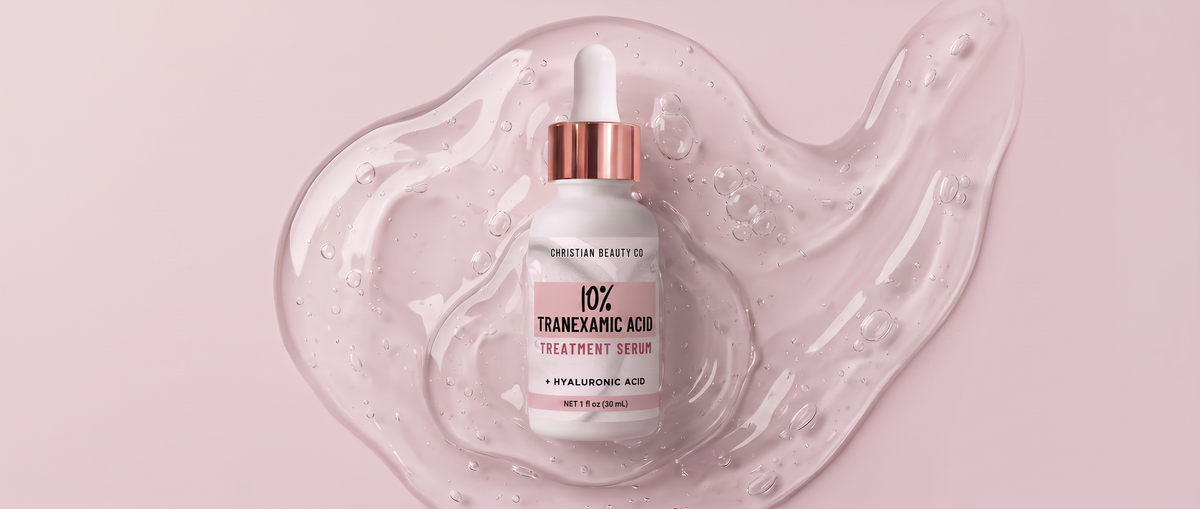
10% Tranexamic Acid Treatment Serum
+ Hyaluronic Acid · 1 fl oz / 30 mL
A full professional-grade dose — more than triple the online average — cushioned in hyaluronic acid for daily comfort. For dark spots, melasma, and post-blemish marks. Morning and night, always followed by SPF in the day.


