
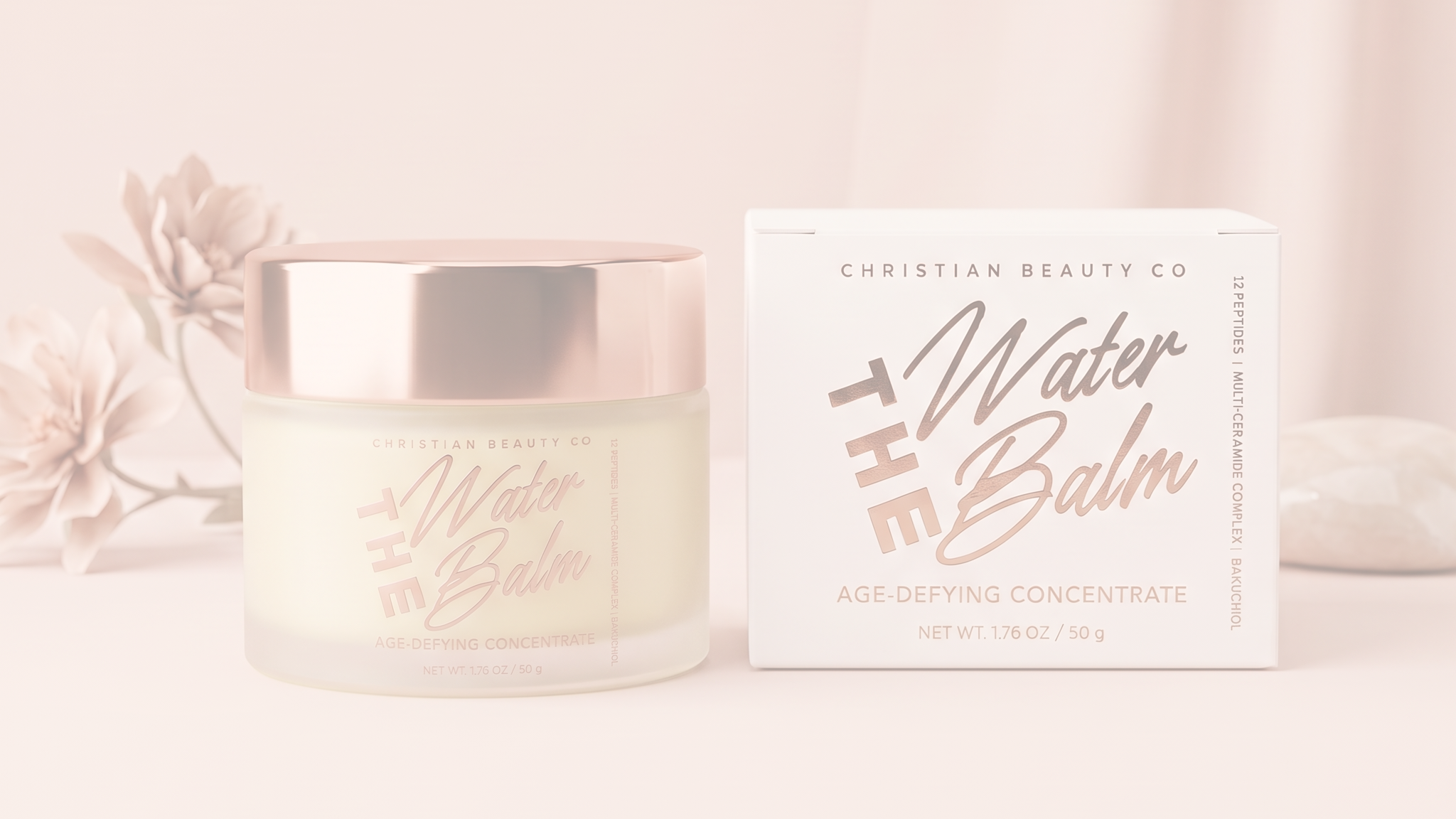
The Balm That Breaks
Like Water
Twelve peptides. Three skin-identical ceramides. A plant-derived answer to retinol. And a texture that performs a disappearing act the moment it touches warm skin.

There is a moment — roughly two seconds after The Water Balm meets your skin — when everything you thought you knew about rich creams quietly rewrites itself. In the jar it is unapologetically a balm: dense, cushioned, almost sculptural. It holds the swirl of your spatula. It looks like commitment.
Then it breaks.
Warmed between fingertips, the emulsion releases its water phase in a cool, quenching rush. The richness dissolves mid-stroke, and what reaches your face feels less like cream and more like a glass of water your skin gets to drink. No film. No weight. Just a dewy quiet where the balm used to be.
But texture is only the invitation. Underneath the sensory theatre sits one of the most deliberate ingredient architectures we have ever sealed under a rose gold lid: a twelve-peptide complex, a complete three-ceramide barrier system, and bakuchiol — each with published research to its name. This is the rare jar where the feel and the science are equally the point.
“It doesn’t sit on your skin.
It becomes water the moment it arrives.”
The Break
a disappearing act in three parts“Breaking” is formulator’s language for the instant an emulsion lets go of the water it holds. Most creams break slowly, invisibly. The Water Balm is engineered to make it the main event — a thick balm-to-water transformation you can feel happen.

Out of the jar it holds its shape — a dense, whipped balm with the bounce of something far too rich to vanish. (It will.)
Body heat undoes it. Within seconds the emulsion breaks, releasing the burst of cool water suspended inside the cream.
It finishes the way a toner might: weightless, dewy, gone. All that’s left is skin that feels freshly rained on.
The Twelve
Peptides are short chains of amino acids — fragments of the very proteins your skin is built from. Applied topically, certain peptides behave as messengers: they mimic the signals your skin sends when collagen has broken down, persuading fibroblasts that it is time to rebuild. The Water Balm carries twelve of them, working four jobs at once.
Collagen messengers — matrikine fragments like palmitoyl pentapeptide-4 that cue fibroblasts to synthesize collagens I, III and IV.
Delivery specialists that shuttle trace elements such as copper — a cofactor for the enzymes that knit skin back together.
Hexapeptides that gently soften the micro-tension behind expression lines, so the surface reads calm rather than creased.
Elasticity support — peptides that reinforce elastin and the dermal scaffolding that keeps skin springy under pressure.
In a twelve-week, split-face, placebo-controlled trial in 93 women, a moisturizer with palmitoyl pentapeptide-4 delivered significant visible improvement in fine lines and wrinkles versus placebo.
Robinson LR, et al. International Journal of Cosmetic Science. 2005;27(3):155–160.
The Three
If peptides are the message, ceramides are the masonry. Your outermost barrier is roughly half ceramide by lipid weight — the mortar between skin cells that keeps water in and irritants out. When levels fall, hydration escapes; skin turns tight, dull, reactive. The Water Balm replaces all three of the ceramides most studied in the clinical literature — the trio researchers label 1, 3 and 6-II.
The most abundant repair lipid — replenishes the day-to-day mortar that holds moisture in place.
Supports the skin’s natural exfoliation rhythm, keeping the surface smooth and light-reflective.
The rare long-chain ceramide that laces lipid layers together — the structural stitch of a resilient barrier.
In a double-blind, randomized, split-site trial, a cream with ceramides 1, 3 and 6-II lifted hydration and reduced water loss from a single application — and after 28 days showed “more significant improvement on skin hydration, barrier function, and skin pH” at every time point, with benefits still measurable seven days after stopping.
Lueangarun S, et al. Dermatologic Therapy. 2019;32(6):e13090.
The One
Every age-defying formula has to answer the retinol question. Ours is bakuchiol — a phytochemical from the babchi plant that switches on retinoid-like renewal pathways without the peeling, stinging or sun-sensitivity that make retinol a difficult houseguest. It is the reason The Water Balm can live in both your morning and evening ritual.
The evidence here is unusually strong for a plant active. In a randomized, double-blind trial published in the British Journal of Dermatology, 44 participants used 0.5% bakuchiol or 0.5% retinol for twelve weeks. Both significantly reduced wrinkle surface area and hyperpigmentation — with no statistical difference between them — while the retinol group reported more scaling and stinging. A 2022 systematic review of 30 studies echoed the pattern across photoaging, tone and blemish-prone skin.
“Bakuchiol is comparable with retinol in its ability to improve photoageing and is better tolerated than retinol.”
Dhaliwal S, et al. British Journal of Dermatology. 2019;180(2):289–296.
Two Seconds, Twice a Day
Morning and night, after cleansing and any serums, take a pearl-sized amount with the spatula.
Press it between fingertips for two seconds — just until you feel the texture give and turn liquid.
Press — don’t rub — into skin until the water phase disappears. Follow with SPF in the morning.
Dhaliwal S, Rybak I, Ellis SR, et al. Prospective, randomized, double-blind assessment of topical bakuchiol and retinol for facial photoageing. British Journal of Dermatology. 2019;180(2):289–296.
Lueangarun S, et al. The 24-hr, 28-day, and 7-day post-moisturizing efficacy of ceramides 1, 3, 6-II containing moisturizing cream on skin dryness and barrier disruption. Dermatologic Therapy. 2019;32(6):e13090.
Robinson LR, Fitzgerald NC, Doughty DG, et al. Topical palmitoyl pentapeptide provides improvement in photoaged human facial skin. International Journal of Cosmetic Science. 2005;27(3):155–160.
Puyana C, Chandan N, Tsoukas M. Applications of bakuchiol in dermatology: systematic review of the literature. Journal of Cosmetic Dermatology. 2022;21(12):6636–6643.
Citations reflect published research on the individual ingredients named, at the concentrations studied — not clinical trials of this finished formula. Not medical advice.

Meet The Water Balm
Age-Defying Concentrate · 1.76 oz / 50 g
Twelve peptides, three ceramides and bakuchiol, suspended in a balm that breaks like water. Morning and night. Every skin, every season.
Full ingredient list +
Aqua, Simmondsia Chinensis (Jojoba) Seed Oil, Opuntia Ficus-Indica Seed Oil, Isoamyl Laurate, Jojoba Esters, Squalane, Pentylene Glycol, Propanediol, Acmella Oleracea Extract, Hydroxyethyl Acrylate/Sodium Acryloyldimethyl Taurate Copolymer, Centella Asiatica Extract, Bakuchiol, Bisabolol, Panthenol, Butylene Glycol, Glycerin, Cetyl Alcohol, Tocopherol, Caprylyl Glycol, Sorbic Acid, Rosmarinus Officinalis (Rosemary) Leaf Extract, Ceramide NP, Ceramide EOP, Ceramide AP, Phytosphingosine, Sodium Hyaluronate, Ethylhexylglycerin, Copper Tripeptide-1, Acetyl Hexapeptide-8, Palmitoyl Tripeptide-1, Palmitoyl Tetrapeptide-7, Acetyl Tetrapeptide-5, Tripeptide-32, Hexapeptide-9, Acetyl Tetrapeptide-2, Palmitoyl Tripeptide-5, Nonapeptide-1, Palmitoyl Pentapeptide-4, Tripeptide-1, Phenoxyethanol.


