Introduction
Tallow foundation is a complexion makeup made with rendered grass-fed beef tallow in place of the synthetic emollients and silicones used in conventional foundations. It combines buildable, mineral-pigment coverage with the skin-compatible lipids and fat-soluble vitamins naturally present in tallow, creating a foundation that supports the skin barrier while it wears. Most tallow foundations are waterless, made in small batches, and priced between $15 and $45 depending on the brand and formula.
That is the short answer. But as the person who formulates our Tallow Cream Foundation at the bench, weighing every ingredient, utilizing high-shear homogenization, and testing every version on real skin, I want to give you the longer one. Understanding why tallow works in makeup, and how advanced cosmetic chemistry transforms it, will help you choose well.
Why Tallow Works on Skin: The Chemistry
Tallow is rendered beef fat, and when it comes from grass-fed cattle and is purified carefully at low temperatures, it is one of the most skin-compatible ingredients available to a formulator. This is not marketing fluff; it is basic lipid chemistry.
Your skin's outermost layer is held together by its own fats: sebum and the lipid matrix between your skin cells. Grass-fed tallow's fatty acid profile remarkably mirrors human skin. It is exceptionally rich in:
- Oleic acid: a monounsaturated fatty acid that gives tallow its effortless glide, helping it absorb deeply rather than sitting like a heavy film on top of the skin.
- Palmitic acid: a major component of your skin's own natural barrier, contributing to long-lasting softness and moisture retention.
- Stearic acid: a structural fatty acid that conditions the skin and, from a formulation perspective, gives tallow-based makeup its beautiful, cushioned texture.
Because these fatty acids closely match what your skin naturally produces, tallow does not behave like a foreign layer. It melts at skin temperature, integrates with your natural moisture, and feels like a second skin. Furthermore, tallow naturally carries fat-soluble vitamins A, D, E, and K. In a leave-on product that you wear for eight to twelve hours a day, you are not just covering your skin, you are actively conditioning it.
This is the core idea behind tallow foundation: makeup and skincare stop being separate steps.
The Myth of the Minimalist Formula: Why 5 Ingredients Are Not Enough

There is a common misconception in the clean beauty space that the shorter the ingredient list, the “cleaner” the product. Let us tackle that head on from a formulator's perspective: if a foundation only contains five ingredients, it is likely skimping on performance.
A simple mixture of pigment stirred into plain fat is a recipe for what many consumers rightfully complain about: a complete midday “grease fest.” Without a sophisticated ingredient architecture, standard tallow foundations and tinted balms will inevitably slide, shine, transfer, and pool into fine lines by 2:00 PM.
The overcorrection is just as common, and I have tested both extremes at the bench. When a formulator fights that grease with the bluntest tools available, loading the formula with zinc oxide or kaolin clay, the pendulum swings the other way: a thick, pasty product that drags on application, sits chalky on the skin, and casts gray on medium and deep skin tones. Clay and zinc will absolutely kill the shine, but they kill the natural, skin-like finish right along with it. A well-engineered tallow foundation lives on the narrow road between those two ditches, and staying on it takes more than five ingredients.
💡 The Formulator's Standard: More ingredients do not equal a “dirty” formula. A clean, high-performing formula is comprised of quality ingredients chosen to deliberately elevate how the product wears and benefits the skin. We formulate strictly using ingredients that carry an EWG rating of 0 to 2.

A thoughtfully crafted, expanded ingredient stack is what makes a product genuinely worth the investment. In the spirit of transparency, the examples that follow come straight from our own bench. When we crafted our Tallow Cream Foundation, we bridged the gap between heavy animal fats and elegant makeup performance by prioritizing the three areas that matter most:
- Resilient extracts and plant botanicals: infusing nutrient-dense plant extracts like antioxidant-rich prickly pear to deliver multi-layered hydration and environmental defense without adding heavy grease.
- Mineral texturizers: utilizing sophisticated, non-toxic minerals like boron nitride and silica microspheres. These advanced ingredients offer oil control and structural grip, creating a lightweight, breathable cream that blurs imperfections without a pasty, heavy residue.
- Adhesion and wear systems: incorporating skin-gripping agents like magnesium stearate and lauroyl lysine. Lauroyl lysine, an amino acid derivative, is a rare find in cosmetics: it is difficult to source, so most brands skip it, yet nothing matches the silky slip and all-day skin adhesion it delivers. These are the ingredients that keep transfer low and coverage in place from morning to night.
Comparing Your Complexion Options

Tallow Foundation vs. Tinted Tallow Balm: Know the Difference
These two product names get used interchangeably online, but they should not be.
A tinted tallow balm is skincare first. It is typically a basic tallow balm with a tiny amount of pigment stirred in. It is sheer, dewy, and meant to slightly even out skin tone while moisturizing. It is beautiful for low-makeup days, but it will not reliably cover redness, blemishes, or hyperpigmentation, and it carries a high risk of looking oily under warm lighting.
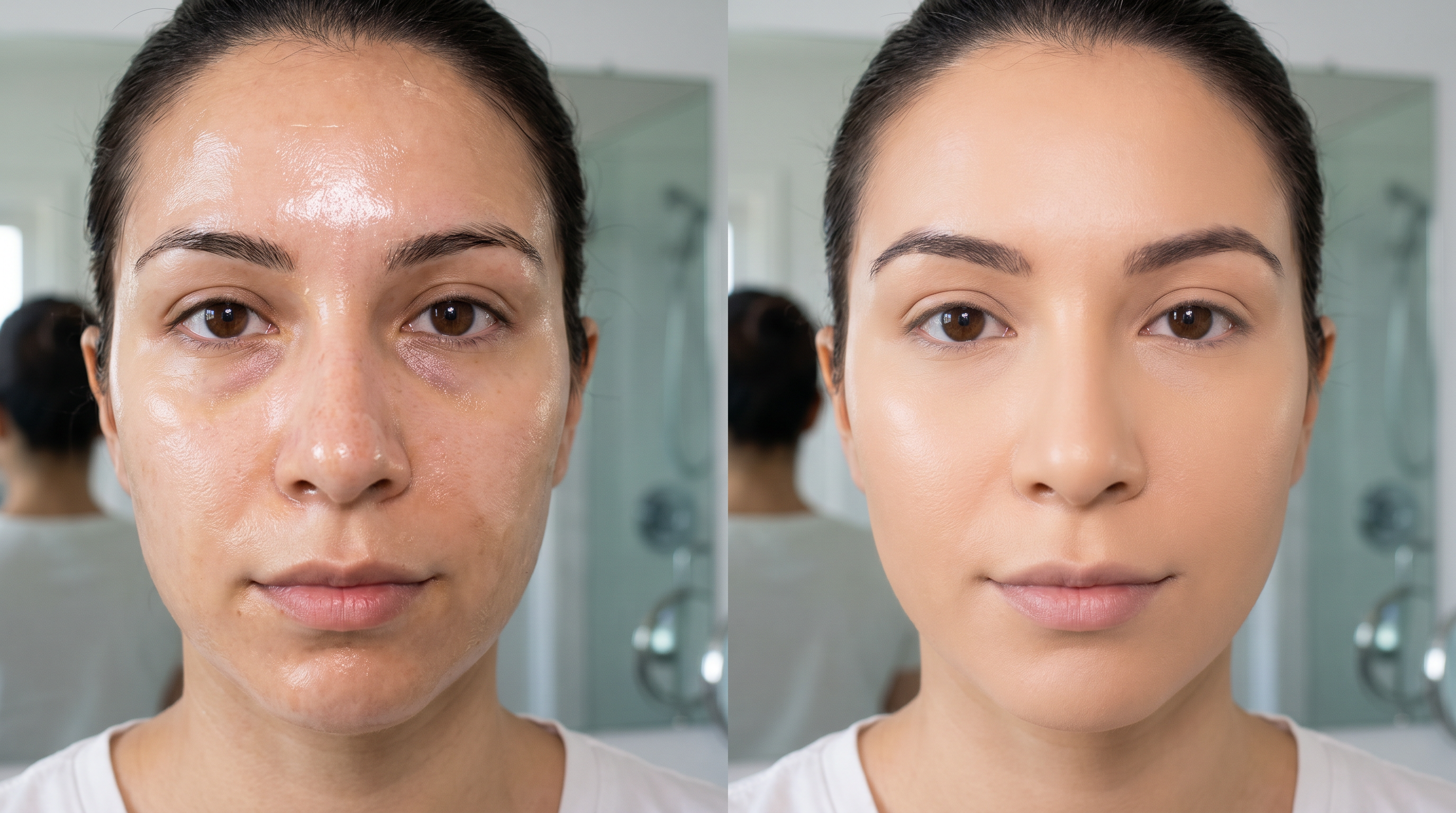
A tallow foundation is makeup first. It carries a true pigment load, an advanced mineral powder system for finish control, and a structure designed for buildable, lasting coverage. It delivers all of tallow's rich skincare benefits, but it performs like a premium foundation because it is engineered as one.
Who Tallow Foundation Is For
Dry and mature skin: This is where tallow foundation truly excels. Skin naturally produces less sebum with age. Replenishing those vital lipids while you wear your makeup, rather than drying out the skin with synthetic films, makes a visible difference in how smoothly the product sits over fine lines and dry patches.
Sensitive skin: Waterless formulas naturally require a much lower preservative load, and leaving out common irritants like synthetic silicones, heavy fragrances, and essential oils makes it incredibly gentle.
All skin depths, when crafted inclusively: A serious foundation line must serve real skin diversity, and true inclusivity is not an afterthought. When developing our line, we broke conventional industry norms by focusing on and finalizing the deepest shades first to ensure rich, accurate undertones across the entire spectrum, rather than simply expanding a light base upward. We proudly offer a comprehensive range of 26 meticulously balanced shades.
“But will it clog my pores?” This is the question I am asked most at the bench. Because tallow is an animal fat, people assume it is highly comedogenic. However, its comedogenicity is generally rated low, around a 2 on a 0 to 5 scale, making it comparable to popular plant butters. Because it so closely mirrors human sebum, the skin recognizes and processes it rather than trapping it in the pore matrix.
If you have exceptionally oily skin, you can absolutely wear a premium tallow foundation, but because it is a lipid-dense product, you should expect a beautifully hydrated finish and plan to lightly dust your T-zone with a clean powder.
How to Apply for a Flawless, Natural Finish
Because a high-quality tallow foundation is concentrated and thermally responsive, meaning it softens with your body heat, application technique differs slightly from liquid synthetic makeup. Before you begin: start with freshly cleansed skin, then moisturize with your preferred moisturizer or facial oil for optimal performance.
From there, choose your method by the coverage you want:
1. Fingertip application, for a natural, sheer melt. Swipe foundation from the tin and gently massage onto the skin with warm fingertips. Your body heat softens the cream into a smooth, workable glide. Build as needed.
2. Brush buffing, for polished, medium coverage. Swirl a dense brush in the tin, then stipple and buff onto the skin. Layer for more.
3. Sponge bouncing, for an airbrushed, seamless finish. Use a damp or dry sponge to pat and bounce the product onto the skin. Damp sheers it out; dry gives fuller coverage.
4. Spatula and warmth, for the highest coverage. Scoop with a spatula and warm the product between your fingers to activate it, then apply directly for the richest pigment and creamiest texture.

Whichever method you choose, the same principles apply: start with less than you think you need, since there is no water diluting this tin and every gram is formula. Build in thin layers from the center of the face outward, where coverage is needed most. And if your day runs long, a light dusting of powder through the T-zone locks the natural finish in place.
How to Vet a Tallow Foundation Before You Buy
You will never see the tallow itself before you purchase, so judge what you can actually see: the label, the listing, and the reviews. Four checks tell you nearly everything:
Read the full ingredient list. A trustworthy brand publishes it; if you cannot find one, move on. Then look past the tallow for the performance work: ingredients like silica microspheres, boron nitride, lauroyl lysine, adhesion minerals, and botanical extracts are what separate a foundation from a balm. If the label reads only “tallow and iron oxides,” you are buying a tinted balm at a foundation price. And note where zinc oxide or kaolin clay sits in the list: when either appears near the top, the formula is likely fighting grease with paste, trading the slick problem for a chalky one.
Find “grass-fed and grass-finished” stated outright. You cannot inspect the sourcing, but a brand can be held to its claims. “Grass-finished” means the cattle were raised on pasture their entire lives, which maximizes the fat-soluble vitamin content. If a listing only says “tallow” with no sourcing language, assume the cheapest input.
Search the reviews for two words: “smell” and “greasy.” Reviews are the only window you have into rendering quality and wear. Repeated complaints about a beefy scent point to poorly rendered, oxidizing tallow. Repeated complaints about midday shine or sliding point to a formula with no finish architecture. A few minutes in the review search bar will save you thirty-five dollars.
Count the shades and check the undertones. A serious foundation line serves real skin diversity across depths, with warm, cool, and neutral undertones represented at every level. Two or three shades signals a side project; a developed range signals a brand that expects to match you.
The Bottom Line
Tallow foundation is not a trend piggybacking on a viral ingredient. It is a genuine rethinking of what complexion makeup can be: coverage built on lipids your skin already recognizes, worn all day as conditioning rather than cost. But the ingredient alone is not the product. The difference between a midday grease fest, a chalky mask, and a foundation you forget you are wearing comes down to formulation, and formulation is exactly the part you cannot see in a product photo.
So read the label. Count the shades. Search the reviews. A brand that has done the work will show it in all three places, and now you know exactly what to look for.
At Christian Beauty Co., we do not believe in choosing between clean ingredients and elite cosmetic performance. Our Tallow Cream Foundation is meticulously handcrafted in small batches right here in New Jersey, utilizing an advanced, silicone-free botanical and mineral stack to deliver a natural finish that lasts all day.


